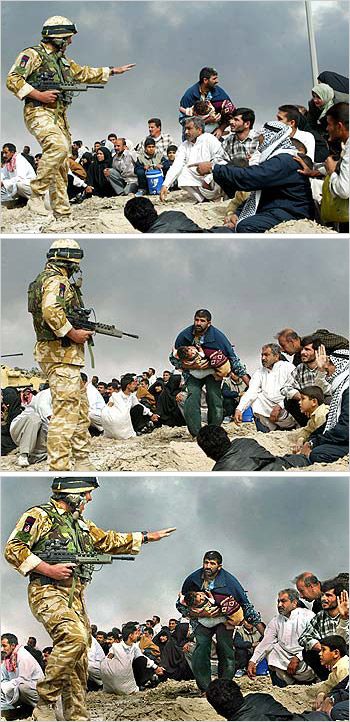
Walski’s original images sent to the L.A. Times, the front page composition-photo is last. Taken from The New York Times
If you’re familiar with the above photos, congratulations on your enrollment in journalism school or your journalism degree. For everyone else, you may remember them from a 2003 scandal surrounding the Los Angeles Times publishing a doctored image. Brian Walski, a staff photographer for the Times who was covering the war in Iraq submitted the altered image – a composite of two others he had taken – and through internal channels of publication it made it’s way to the Hartford Courant and The Chicago Tribune as well. It was quickly discovered to be a fake, and Walski summarily lost his job and has been made an example of to this day.
So much so in fact that I’ve encountered this photo and this story of Walski’s ethical foible in no less than five different journalism classes. I imagine it’s been the same for many others since the scandal itself first broke. It contains a neat little ethics lesson for aspiring journalists – don’t submit fraudulent work – and also a gleeful ego boost – he lost his job and is now a wedding photographer apparently. Or at least, this is what my class laughed about when most recently retreading the ethics lesson.
High-ish-Stakes
It’s a little jarring then to consider that while we laugh at this man who undoubtedly violated a code of journalistic ethics, the people who actually lied about the pretenses for the war have mostly gone unpunished.
While five separate classes, professors, and curricula have made sure to mention the event, exactly zero of them have attempted to draw ethical lessons from the fact that nearly the whole mainstream media gleefully amplified the false pretenses for a war. A war whose interminable duration is now only ever measured by a chain from the last atrocity’s distance to the latest atrocity.
As Elspeth Reeve captured in her 2013 article for The Atlantic, the people who boosted the war have now courteously offered mostly deflective mea culpas about their mistakes. Named in the piece are David Frum, who joined The Atlantic as a senior editor in March 2014; Jonathan Chait, who still writes for New York magazine; and Ezra Klein, founder and editor-at-large of Vox.
Six years on from the writing of Reeve’s piece, excuses like “I was powerless to stop the war anyway,” and “I was a dumb college kid,” should somehow manage to fall even flatter than they deserved to when first uttered.
Hate the Player, and the Game
Frum’s impunity is particularly egregious. He was a speechwriter for George W. Bush and infamously coined Iraq, Iran, and North Korea as a new “axis of evil” who were supposedly plotting the downfall of America in Bush’s 2002 State of the Union address. As Alex Nichols of The Outline reported in 2017, MSNBC had him on the network 40 times in a single year, mostly to criticize Trump.
It’s difficult to argue Frum has not played a critical role in American foreign policy post-2000, despite his own hand-waving apology that he could not have stopped it alone, and yet there have been no ramifications to speak of. Tuesday’s State of the Union address showed Trump mirroring Frum’s stance on former president Obama’s deal with Iran over their nuclear capabilities. As Nichols details, Frum’s rhetoric about Bush withdrawing from the Kyoto protocol was more or less borrowed by Trump when he spoke of withdrawing from the Paris Agreement. Frum may act like he doesn’t like Trump, but it is clearly an aesthetic decision.
Atrocity Amnesia
Perhaps most unfortunate is that Frum’s impunity does not represent the greatest extreme of apologism for war either. When Defense Secretary James Mattis resigned in 2018, it was to the public chagrin of lawmakers and media members on both sides of the aisle. The narrative was as it had been when he was nominated, he was a stabilizing force – the adult in the room corralling Trump – and his presence would be sorely missed.
As CBS News reported, Senator Ben Sasse (R-NE) mourned the necessary advice he had been giving Trump. Nancy Pelosi (D-CA) said she was sad and shaken by his departure. Ranking Senate Intelligence Committee Member Mark Warner (D-VA) called the departure scary as Mattis had been “an island of stability amidst the chaos of the Trump administration.”
I doubt very much then that any of the media figures or politicians who made comment on Mattis’ departure cared to reflect on his actual service history. As Aaron Glantz wrote for Reveal in 2017, his firsthand observation of the sieges of Fallujah in April 2004 was a catalog of what are unquestionably war crimes. Marines, under the command of Mattis, fired on ambulances and aid workers. They prevented civilians from escaping by blockading the city. Elsewhere soldiers posed for photos with people they had killed. As Glantz writes, “Marines killed so many civilians that the municipal soccer stadium had to be turned into a graveyard.”
Dahr Jamail of Truthout wrote of his firsthand experience with the siege of Fallujah in 2016. By his reporting, more than 700 civilians were killed by the US military during the April 2004 siege. The November assault later that year killed another 5,000 civilians. I think it’s safe to say that, contrary to Senator Warner’s comments, the scariest part of Mattis’ tenure as Defense Secretary is that none of this ever disqualified him from being the adult in the room.
Of course, President George W. Bush himself also received quite the rehabilitation by media early in December 2018. A few weeks before Mattis’ sudden departure, at the funeral of President W. Bush’s father, his exchange of a candy with former First Lady Michelle Obama spawned adoring coverage from – a quick google search yields – CNN, Oprah, Time, NBC, Today, and far, far more. In October 2018, Michelle Obama told USA Today that George W. Bush is her “partner in crime.” What type of crimes? If I had to guess I’d say war crimes most likely.
An Ethics Lesson
It was Greek philosopher Heraclitus who is credited with the saying, “No man ever steps in the same river twice” and I must borrow from his wisdom now when considering the ethics lessons Walski’s photo has taught me. That there is no real punishment for lying to cause a war, nor is there really one for credulously repeating those same lies. That there really isn’t much punishment for committing war crimes either, whether through actual criminal charges or even lasting social sanctioning. What there is punishment for, is photo editing.
 Kyle is a four-letter word